

The Tottenham forward’s father, Son Woong-jung, was a former professional footballer who made it to a good level in South Korea, and he had begun to coach his boys, making it his mission to guide them to the top, avoiding the pitfalls that he encountered.
In an interview, the South Korean forward revealed he's father told him not to get married while playing football.
“He gave us four hours of keepy-uppies,” Son says. “Both of us. After about three hours, I was seeing three balls. The floor was red [through bloodshot eyes]. I was so tired. And he was so angry. I think this was the best story and we still talk about it when we are all together. Four hours keeping the ball up and you don’t drop it. That’s difficult, no?”
Wait, what? Son did not let the ball hit the ground? In four hours? As a 10-year-old? “No,” he says. Impossible! Son’s gaze is steely. “No, not once,” he replies.
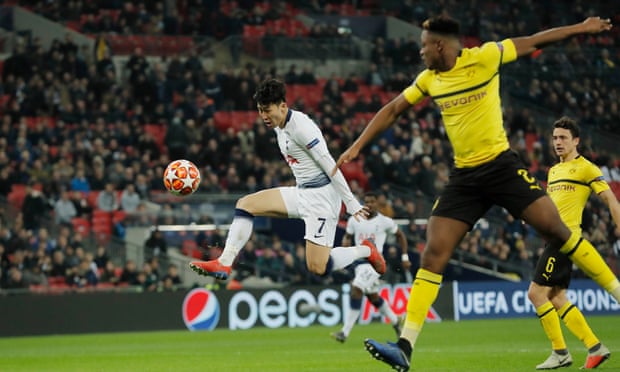
“As soon as I could walk, I was kicking a ball,” he says. But what shines through and has underpinned his rise, to the point where he can be considered as the pre-eminent player in Asia, is his readiness to respond to the demands of his father. That, and his extraordinary levels of focus and dedication.
Son recounts another tale that features his father and keepy-uppy punishments. “When I was 10 or 12, he came in to coach my school team and we were training, 15 or 20 players. The programme was for us all to keep the balls up for 40 minutes. When someone dropped the ball, my father would not say anything. But as soon as I dropped it, he made us all start over from the beginning. The players understood because I was his son and, yeah, it was tough. But when you think about it now, this was the right way.”
It is tempting to pigeonhole Son’s father as a remorseless disciplinarian and wonder whether his drive affected the relationship between the pair. It would be wrong to do so – the reality is that Son has nothing but admiration and respect for him. “Was he a strict coach?” Son says. “Yeah. Scary, as well.” Yet the tone is affectionate. In Korean society, a father’s word tends to be law. Son has followed it; he has embraced it.
“My father was thinking of what I needed all the time. He has done everything for me and, without him, I probably wouldn’t be where I am today. As a player, you need some help. It’s also important to meet a great manager and there’s luck, too. Everything has come together for me.”
It has been a remarkable nine months or so for Son, beginning at the World Cup last June, when his South Korea team were eliminated after defeats against Sweden and Mexico, but went on to beat Germany in their final group match. After the Mexico game, the 26-year-old sobbed uncontrollably when the South Korea president, Moon Jae-in, visited the dressing room.
“Mid-November was 100% a big period for me,” Son says. “I’d been travelling a lot. I didn’t feel great. I had so many things in my head. It was just a bit rough. The gaffer made the choice and it was perfect for me – some hard training at Spurs and a bit of rest. As I said before, you have to have the luck to meet a great manager. I’ve improved an amazing amount under him.”
“My father told me when I was young that if I was through on goal but an opponent fell and hurt themselves, I should put the ball out and check on the opponent. Because if you’re a good footballer but don’t know how to respect others, you’re nobody. He is still saying that to me. Sometimes it’s difficult but we are humans before we are footballers. We should respect each other. On the pitch, off the pitch – why should it be different?”
“My father says this and I agree, as well,” Son says. “When you marry, the number one will be family, wife and kids – and then football. I want to make sure that while I play at the top level, football can be number one. You don’t know how long you can play at the top level. When you retire, or when you are 33, 34, you can still have a long life with your family.”
“Yeah, because there are many opportunities to do things off the pitch, like drinking or something like this,” he replies. “But I am not the type that likes doing this stuff.
“I just want to make sure that I make everyone happy by playing at the top level. For example, when I play for Spurs at Wembley, how many Korean flags do you see? I want to keep my level as high as possible for as long as I can, to pay back to them. This is very important for me.
“Do I feel like an ambassador for my country? Of course, I have to be. Another example: when we play at 3pm, it’s midnight in Korea. When we play Champions League at 8pm, it’s five in the morning and they still watch on TV. I have to pay back; I take a lot of responsibility. This is what I am enjoying.”
“There are different attitudes in Europe and Asia and, of course, people are thinking: ‘Why is he living with his family?’ But who cares about me? Who is helping me to play football? It is them. They gave up their life and they come over here to help me. I have to pay back.
“I am so grateful to them and I really am grateful for every single opportunity to make this. I know that being a professional is about more than talent. It’s like my idol, Cristiano Ronaldo, who actually works more than the talent he has. I see many players who don’t have the mentality, who think that talent is enough. But it’s not. It’s the things you are doing extra.”
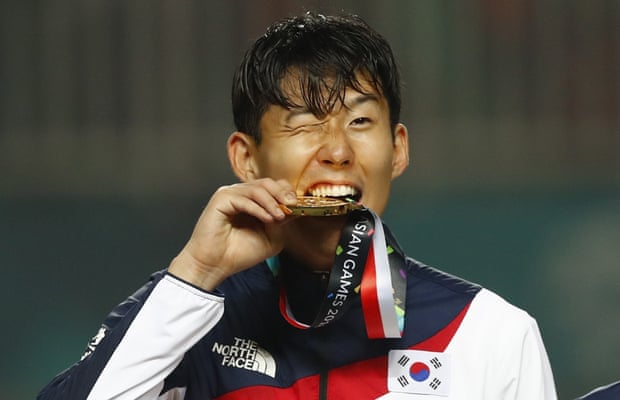
Son has always put in the hard yards. Even when he broke into the Hamburg team at 18, his father – on visits from South Korea – would put him through gruelling additional workouts. There have been numerous moments when it has all felt worthwhile, with the Asian Games triumph prominent among them.
To many South Koreans, it was more about Son winning his freedom from military service than winning a tournament – which shows the affection in which he is held. Unsurprisingly, Son is having none of that and, as an aside, he will undertake the basic, four-week soldier’s training course either this summer or the next.
“It was a massive tournament – not because of me – and, when it was such a big thing, I was very happy and proud to win it; proud of my country, proud of my teammates,” Son says. “As I’ve said before, it was not my aim to avoid military service. My aim is simply to be great as a footballer – all the time. This is one part of that.”


No comments:
Post a Comment